We mentioned in a previous post that we're beginning a map of shame for gas stations who "don't have a bathroom." We figured it was only fair to give a pat on the back to those that do it well for families that are traveling across this great land of ours.
So we're starting a Thumbs Up Map. We'll update the Thumbs Up Map whenever we stumble across another great ice cream place, motel, restaurant, gas station, or any other place that makes family travel even better.
Showing posts with label General Travel Tips. Show all posts
Showing posts with label General Travel Tips. Show all posts


Choosing a Family Road Trip Vehicle
When we were looking for a new roadtrip vehicle, it was an interesting choice. There are many choices available, station wagons, mini-vans, SUVs, compact SUVs, cross-over vehicles, and stuff like used vanagons and PT Cruisers.
Mini vans let you split up the kids
Mini vans have a few advantages over other vehicles: tons of cargo room, three rows of seats so that you can either carry many people or split up a couple of kids. (This is something they like as much as something we like).
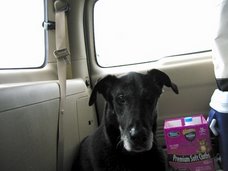
We've used a Dodge Caravan at length because the company I work for has a small fleet of them for us to use on photo shoots and other trips. The Caravan is a wonderful roadtrip vehicle -- comfy, zippy, and there's tons of cargo space. Even a big dog like Wookie would fit quite well for extended trips. We rented a Ford Aerostar for a trip a few years ago and it felt like a hunk of junk. A couple of years ago we rented a Chevy mini van which we liked quite well.
We were looking at a Caravan and a Toyota Sienna.
Crossovers are zippier but still with lots of room
We took a trip from Nashville to New Orleans and back recently in a rented Kia Rondo, a crossover vehicle I guess, but it really felt like a mini mini-van. We liked the ride and the inside setup quite a bit, and there was plenty of cargo room. The gas mileage was OK, a little better than a mini van, but still in the lower 20s. I think this type of vehicle could be a great choice. The Kia's main drawback was that when one of the windows (especially the rear ones) were opened (partially or fully), a horrible pulsing pressurization would overcome the car. Like your ears would explode if subjected to it much more. Other than that, we liked it.
Mazda's and Toyota's mini mini-vans look really good, and we'd like to check them out. Maybe the next time I rent a car, I'll try to get one. Mazda has one with three rows of seats so you can split the kids, boost gas mileage, and maintain quite a bit of cargo room.
Compact SUVs have lots of vertical storage
There's more cargo room in the Subaru Forester than in either the Outback or the Legacy. But the cargo room is vertical -- you need to pack stuff on top of stuff, and long stuff is either out of the question or on the roof. Despite their higher center of gravity and larger shape, the Subaru sales man said that all three models get about the same mileage -- because they have identical power trains, the body shape, he said, was pretty much irrelevant. I suspect he's mostly right, but if so, why do Olympic athletes get so anal about friction and drag?
PT Cruisers are in a class by themselves (so to speak).
I've also rented PT Cruisers a couple of times on photo shoots. I don't know how to classify them. Maybe crossover vehicle? But crossover between what? They're almost like small Chevy Suburbans. There seems to be a lot of space, they're sporty, and they do very well over speed bumps (hey, it was a rental, I owe it to readers to find these things out). The window controls, though are no where near where you would expect them to be: they're in the center of the dashboard. Not on the door or the center console. In the dark, things like this are a pain in the neck.
Station wagons use less gas and have a lot of space.
In the end, we chose a Subaru Legacy. The mileage was purported to be 28 highway, but on our maiden voyage, we got 30 or better (hiper miler techniques employed). The cargo space is plenty sufficient (we were able to bring all of our camping gear). And the cup holders are fine. The look is super sporty. We had a roof racjk added so that we can boost cargo room when needed, but at a gas mileage price. But we figure, Why take the hit on mileage with a mini-van every day of the year when you can only take the hit when you need the extra cargo room?
Cup holders matter more than some might think
The Subaru guy was amazed at the fact that he was about to lose a sale because the '98 Outback (only 68,000 miles!) had cruddy cup holders. I didn't see them on my test drive, and when I returned to the lot, I parked it, walked up to Tinsley, tossed him the keys and said to her "There are no cup holders." Tinsley shook her head, Trevor scrambled to the car to look, and found them: a dinky, rickety little tray the slips in to the dashboard. Tinsley and I rolled our eyes.
What's your road trip vehicle of choice?
Is School more Important than a Family Road Trip?
 When you pull a kid from class for a week, you disrupt the lesson plan of the teacher and slow your child 's progress. But travel can develop strong family ties and provide a richer learning environment than any cement building in a kid's home town. If you develop an educational agenda, you can make roadtrips a fun and enriching experience.
About a year ago there was a discussion at Fodor's Forum on whether it was a good idea or a bad idea to take kids out of school for a family trip. Many thought it was fine, some others felt strongly that it was disruptive of the school routine and therefore that it was bad for the kid, bad for the teacher, and bad for the other students in your child's class.
I feel differently.
Travel presents endless opportunities for education, if you let it. My feeling is that the most important things in life are not taught at school. That’s not to say that school isn’t important, but that schools can't teach the critical lessons. They can barely afford a field trip to the science museum, let alone a trip to Europe. You learn by walking around a place, smelling the air, seeing the sights and tasting the (yuk) escargot. And asking questions.
I travel a lot for work; if it's not too far we pack up the family and head out. We feel that every road trip is an opportunity to teach our kids about this country: people; rocks and volcanoes; fish, bees, cactus and trees; government, wars...
Don’t bring the same old books from home for the kids to read, get books from the library about where you’re going. Start reading a couple of weeks before you go. And make scavenger hunt scrap books as escargot describes. We’ve had a ton of success with an old point and shoot digital camera with our son who is now six. Take some time to learn about some cultural or natural history to use as talking points on your trip.

- Compassion, which you learn by understanding many different points of view.
- Diplomacy, which you learn by experiencing many different cultures.
- How to manage your money, which can be taught while traveling.
- How the natural world works, which makes a lot more sense when you’re standing in the middle of it (it’s hard to picture the size of a glacier when you’re in a class room, but a lot easier when you’re standing in Glacier National Park or next to the Mission Mountains as in the photo).
Maybe the most important thing is learning and experiencing new things with your family.
The world needs more smart people making smart decisions and asking the right questions. Much of what goes wrong in the world is because adults do dumb things: lie, steal, ignore the obvious, and fail to ask questions about the big picture.
What do you think?
Family Travel all about 'Quality Time'
From the Chicago Tribune a while back
Family travel all about 'quality time'
BY ALFRED BORCOVER Special to the Tribune November 18, 2007
It's all about QT. Kids are busy with soccer, basketball, baseball, music lessons, video games and camp, not to mention school. Parents are overburdened at work and equally busy on weekends trying to hold lives together. QT -- quality time -- with children seems to be catch-as-catch-can. And pretty soon months have rushed by without the family having fun together.That's where family travel comes in. Not just jumping in the van and sightseeing helter-skelter, kids rolling their eyeballs every time you drag them into a museum. But doing things kids want to do, having a shared adventure blended with an educational experience. Or just splashing around together at a lake or ocean beach.
Travel with children has been on a steady climb since 2000, and even more so in the last seven years. According to Washington-based Travel Industry Association figures, the number of leisure vacations with children has risen nearly 14 percent, to 208.3 million trips in 2006 from 183.1 million in 2000. Some of these trips are taken with grandparents.
"From 2001 through 2004, the primary reason [for the growth] was the residual psychological impact of 9/11," said Peter Yesawich, chairman and CEO of Ypartnership, an Orlando-based travel research and marketing firm. "People became far more introspective. Money, which was the focus of the late 1990s, was no longer all important. All-important was quality time with loved ones, a sense of parental guilt.
"Yesawich continued: "We began to see another reason [for family travel]: work habits that have become increasingly frenetic. The workday has gotten longer because of technology -- cell phones, PDAs and ceaseless e-mails. If you look at households where you have mom, dad and kids, 60 percent of those are where mom and dad are both working full time."
Yesawich said a pressure-cooker basically has evolved because mom and dad are struggling to keep up with their work obligations, "which means they feel guilty they don't have time to spend with their kids, which in turn translates into the conclusion, 'well, when we get three or four days to take a vacation, the kids are coming along.'"About those vacations. Yesawich said the No. 1 family getaway involves visiting friends and relatives. Beyond that, he said, priorities include anything that has to do with water -- beach and lake vacations and water parks, followed by theme parks and cruises, increasingly popular with families.
About 80 percent of vacationers in the U.S. take at least one trip a year by car, especially true for families who are cost conscious. Only half of vacationers fly. When you're traveling with kids, you look for the best deals, he said.
But what's truly essential when planning a family vacation is involving the kids. What you don't want are bored children and constant kvetching. When Yesawich conducted his annual National Leisure Monitor survey in January, sampling 1,882 leisure travelers, he found that kids play a significant role in determining where the vacations will be taken, where the family will stay and what they're going to do. "Kids go online and help plan vacations," Yesawich said. "
Kids save part of their allowance to participate in vacations. They are invested emotionally in the trip. One out of every two decisions is influenced by children, which is quite remarkable."For families looking for special shared-experience vacations, package vacations are growing as quickly as the whole travel-with-children boom. While growing, tours and family adventure packages are a "very thin slice" of the family travel market, Yesawich noted. Overwhelmingly, people are packing up the family car for their trips, he said."
Over the last three years alone, the family travel end of our business is up 30 to 40 percent," said Dan Austin, director of Austin-Lehman Adventures, an outdoors adventure-oriented tour operator based in Billings, Mont. "It makes up about 50 to 55 percent of our business." Austin-Lehman's family tour packages focus on the Pacific Coast and Northwest, California, the Rocky Mountains and the Southwestern U.S. A few go to Central and South America, and one to Africa. All have physical components such as biking, hiking, kayaking and rafting as well as cultural activities."It's a way for families to maximize what little time they have," Austin said. "
Whether it be with us or whomever, a package tour, where you've got experts who have vetted the places to stay, the proper trails and routes so you're not taking a lot of misdirections, is going to give you the most bang for your buck."As for kids, Austin said, they're in the outdoors and experiencing new things. "We wear them out a little bit. They may go for four or five days before they realize the place their staying doesn't have TV." (www.austinlehman.com; 800-575-1540)
Paula Weissman, a 44-year-old stay-at-home mom from Long Grove, said she found Austin-Lehman on the Internet while searching for family vacation ideas when her children -- now 15, 13 and 11 -- were too young for such adventure trips. When the time was ripe, Weissman and her husband, Ken, now 47, a businessman, took their kids, who love the outdoors, to Yellowstone. "It integrated physical activity, a diverse itinerary with seeing, learning and doing. We didn't know what to expect. We were exhausted at the end of each day." Undaunted, the following year they went to Alaska and then the Canadian Rockies, trips etched in their family memories.Tauck, a tour company since 1925 and most notably for seniors, jumped into the family travel pool in 2002 with six offerings, said Joanne Gardner, marketing manager for Tauck Bridges, its family brand. The family market has been growing by 15 percent a year, she noted. Starting in 2008, the Norwalk, Conn.-based firm will add four more programs, bringing its portfolio to 13 all-inclusive multigenerational packages on four continents. ( http://www.tauck.com ; 800-788-7885.)
At the high end of the family market is Oak Brook-based Abercrombie & Kent. "We've seen a 22 percent increase in the number of families traveling with us in 2007 compared to 2006," said George Morgan-Granville, president of A&K in the U.S. Its biggest increases have been to the Galapagos and Egypt. But its newest 2008 tour, especially hot for kids, is the Lewis & Clark Montana Adventure, which includes a night in a canvas tepee, and canoeing and hiking in the White Cliffs region with a local Blackfeet historian and guide. ( http://www.abercrombiekent.com ; 800-652-8607.)
Butterfield & Robinson (www.butterfield.com; 866-551-9090), best known for its bicycle tours, and Country Walkers (www.countrywalkers.com; 800-464-9255) now offer a wide variety of family trips geared for children -- with their parents or grandparents, of course.
Pet-Friendly New England Travels
There's a cool guide to pet-friendly travel guide at the Boston Globe's web site, here. Places to roam with Rover, dog-friendly parks in Boston, pet-friendly lodging, pet-friendly attractions, dog parks and trails, and Boston kennels.
Also, a photo gallery of travel pals.
Decompress on a Train through the West
 Ride the American Orient Express through the west's most beautiful National Parks.
We haven't taken this train ride, but we read about it a while back, and have been dreaming about it ever since. While this could be fun with kids, it seems more like a romantic getaway for parents while the kids are in summer camp. Partly because it's expensive, partly because train rides offer a little less flexibility than is optimal when traveling with kids.
The trip takes nine days to wind through Grand Canyon National Park, Yellowstone National Park, and Grand Teton National Park. On the way, the train stops in Salt Lake City, Utah, Las Vegas, Nevada, Sedona, Arizona, and Santa Fe, New Mexico.
The accommodations are classic, yet modern. The fully restored vintage streamliner carriages have individual controls for air conditioning and heat, and most of the cars have a private shower and toilet. Also aboard are (of course) lounge and dining cars and a domed observation car with 360-degree views, which ought to make some great photography opportunities.
With prices beginning at over $5,000 per person, this is not a cheap trip, but it may make a great anniversary vacation. Click here for more information.
Has anyone out there ever taken this trip?
Five Family Travel Trends to Look For
According to the UK's Times online we family travelers ought to be on the look out for some new trends in our 2008 travels.
1. ‘Parent-Friendly’ will replace ‘child-friendly'
Siân Williams, founder of Baby Friendly Bolt Holes expects more stuff for "mum and dad" in addition to the stuff aimed at quieting the kids. We've found this to be at least a little true with the creeping in of espresso machines at various Residence Inns (thank you Mr. Marriott).
2. More adventure family travel
"We are finding families requesting different itineraries for different ages, and going for the idea of being reunited at the end of the day around a bonfire, or authentic ‘asado’, to share stories about their day" says Emmanuel Burgio, founder of US-based travel boutique Blue Parallel. "We are getting particular requests for Peru, where there is much to learn about the culture, and natural wonders such as the Perito Moreno Glacier in Patagonia”.
3. Less adventure family travel
“I predict a growing trend for ‘soft’ family adventures throughout the world" forecasts Andrew Dunn, managing director and founder of Scott Dunn, who says that they're already experiencing this trend. "When the brood have grown bored of the beach, a soft family adventure is just the ticket for injecting fun, excitement, learning and passion for travel and culture into children’s lives. Having children does not mean the end of adventure, if anything it is just the beginning.
4. Reduced carbon footprint
Mandy Ley-Morgan, marketing manager of Luxury Family Hotels:"Over the past six months, we have noticed the average length of stays at our luxury family country hotels double from two nights to four. Our customers are now making the UK either their main or second holiday of the year - instead of previously having their big holidays abroad in France or Spain. Customers are telling us that they wish to reduce their carbon footprint, are fed up with long security airport queues and that there are now more family-friendly holiday options in the UK.”
5. Luggage kids can ride
"I know, having young children myself, that travelling with them can make holidays very stressful" says Justin Cole, general manager of OctopusTravel, "Trunki – the world’s first ride-on suitcase for kids - is a great idea to keep them amused - and it is practical as well!"
Our prediction:
Families will travel lighter in smaller cars while visiting national parks.
Travel destinations should learn to accommodate lighter travel to add value.
What do you see happening on the travel horizon?
Local Flavor is Infused into Local Restaurants
 I traveled to Orlando this past week for the International Builder's Show. On the flight down, I was reading a book called Small Giants by Bo Burlingham. The subtitle is "Companies that choose to be great instead of big". It's like Good to Great for privately-held companies, like our business, WhistlePig Press. Anyway, I ran across an interesting few paragraphs in a chapter called The Mona Lisa Principal. Burlingham writes about a restaurant in Ann Arbor Michigain called Zingerman's Deli and quotes one of the owners, Ari Weinzweig, talking about the relationship between company and community.
"You're talking about something like what that the French call terroir. It has to do with the way the soil and climate in a given region contribute to the flavor of the food. That's because the soil's mineral content, the amount of sun and rainfall it gets, the local vegetation, and so on -- all that is different in each region. So lets say you're going to make cheese or wine using the same recipe in two different places. The animals in one place will be grazing on different vegetation from those in the other, and the grape vines will be growing in different soil and getting different amounts of sun and rain. Because the terroir is different, the cheese will be different, and the wine will be different, even if you follow the same process for making them. It's the same with some businesses. Every community has its own character, which is sort of a spiritual terroir".
The author then explains that the opposite is also true, that when a business is hermetically separated from a community, you can taste that too: "When you mass-produce food, you strive to take the terroir out. The whole idea is to remove any variations due to climate, soil, or season, much as companies that are spread out geographically strive to reduce variation and develop a common culture.
That's why it is so much better to eat at local restaurants than chain restaurants. Yes, we recommend Cracker Barrel. Cracker Barrel is great for driving because it's close to the highway, there's plenty of parking, the food is fast, family-style, and the atmosphere is kid-friendly (you can eat breakfast any time). And they have great gift shops for after supper (or breakfast as the case may be). We recommend Cracker Barrel as a matter of convenience; it's a predictable experience. As it turns out, there is wonderful regional variation in the food as well -- don't order fried catfish with beans and greens in New England, skip the clam chowder in the south, try the meatloaf in both places).
There must be some Tennessee terroir in the corporate culture at Cracker Barrel.
I Love My GPS!
 I never thought I'd say it, but paper maps aren't the best way to travel.
There, I said it.
I'm a map guy. The bigger the better. In college, I used to tack US Forest Service maps on the wall in my office. They extended up onto the ceiling and down to the floor. After college, I worked as a biologist on a fishing trawler in the Bering Sea in Alaska. We had a Global Positioning System device on board, which basically tracked our position all over the open sea. It was a strange new device that cost a ton, but was worth it for fishing boasts in one of the most dangerous places on earth.
The GPS device we had on the Northwest Enterprise didn't have a little map; it simply told us our longitude and latitude which we used to plot our location on the charts. Fast forward twenty years, GPS devices are available in cell phones. My how times have changed.
But I'm a map guy. As useful as a GPS was on a fishing boat a hundred miles from land, I simply couldn't see the value in a teeny screen with a teeny map on it. Until Tinsley bought one for me for Christmas. For fun, I punched in a few addresses and had the device lead me around town, which seemed pretty useful. But the other night I had to attend a dinner party for work. It was a dark and foggy night and the house was on a skinny country road in west Connecticut. There was no way I could possibly read the street signs , mailbox numbers, or even see the lines on the road for that matter. But my new Magellan Maestro 3100 brought me there and home without a hitch.
I'll still use a road atlas for the big picture, but when I get to the city, or town, and need to find a particular address, I'll flip on my GPS and set my mind at ease. It even has little icons that point out gas stations, banks, and grocery stores.
I'm sold. Buy one.
Subscribe to:
Posts (Atom)


 Posts
Posts