Showing posts with label American Backroads: west. Show all posts
Showing posts with label American Backroads: west. Show all posts
Getting the Itch for a Summer Road Trip
I need to be in Montana this summer for some video shoots and other job site visits. Was planning to fly the family out to Spokane and rent a car, but we're wondering if maybe we ought to seize the opportunity and drive the whole danged way.
This route would take us through Niagara Falls to Chicago where we could pick up Route 66. We could drive 'America's Main Street' to St. Louis where we'd head west to Colorado, then north to Montana.
The drive back could swing through Michigan's Upper Peninsula, through Ohio, and across Pennsylvania.
It's been about 13 years since Tinsley and I have had a 2,000+ mile road trip, and maybe time to really break in the kids (or break them down?)
What do you think?
What would YOU do?


Decompress on a Train through the West
 Ride the American Orient Express through the west's most beautiful National Parks.
We haven't taken this train ride, but we read about it a while back, and have been dreaming about it ever since. While this could be fun with kids, it seems more like a romantic getaway for parents while the kids are in summer camp. Partly because it's expensive, partly because train rides offer a little less flexibility than is optimal when traveling with kids.
The trip takes nine days to wind through Grand Canyon National Park, Yellowstone National Park, and Grand Teton National Park. On the way, the train stops in Salt Lake City, Utah, Las Vegas, Nevada, Sedona, Arizona, and Santa Fe, New Mexico.
The accommodations are classic, yet modern. The fully restored vintage streamliner carriages have individual controls for air conditioning and heat, and most of the cars have a private shower and toilet. Also aboard are (of course) lounge and dining cars and a domed observation car with 360-degree views, which ought to make some great photography opportunities.
With prices beginning at over $5,000 per person, this is not a cheap trip, but it may make a great anniversary vacation. Click here for more information.
Has anyone out there ever taken this trip?
Take A Drive With Janis Joplin's Ghost
I saw this in the Hartford Courant April 29, 2007 from the wires. Maybe when I travel down to the gulf coast I'll add this in and report back.
Head down to Port Arthur, Texas - in a Mercedes-Benz, if possible - for a new self-guided Janis Joplin driving tour. The 15 stops include her childhood home, churches, schools and the Museum of the Gulf Coast, which has an exhibit devoted to the rock and blues singer. For more information about the tour, call 800-235-7822.
A Great Drive in Western, MT
The Annaconda-Pintlar Scenic Route from Polaris, MT:
I used to have a cabin on top of a mountain a little north and west of Drummond. The Pintlar mountains and the Deer Lodge Valley was the view from my living room. It was nice. And so is this drive (created in response to a question at Fodor's message board aboiut what to do while in Polaris, MT).
More stuff to do:
- Elkhorn Hot springs
- Jackson Hot Springs
- Bannack Ghost town
- Virginia City (sort of a ghost town, but really, not such a ghost town)
- Clark Canyon Recreation Area
- If you like to fish, you can lose yourself in the Bighole River. Great trout fishing.
- There's an Arnold Palmer designed golf course in Anaconda, the Old Works course.
Great drives in the West: Route 66 Arizona
Ever seen the Pixar movie Cars? Did the kids love it?
Wanna see the real Radiator Springs?
It's actually called Peach Springs and it's along the wide bend of road pictured below.
View RT. 66 in Arizona in a larger map
"...and they come into 66 from the tributary side roads, from the wagon tracks and the rutted country roads, 66 is the mother road, the road of flight."
-- John Steinbeck, The Grapes of Wrath
Route 66 was created on paper in 1925 when Congress decided to join the local roads between Chicago and Los Angeles. By 1938 it was continuously paved. America's Main Street linked small towns in the west to Chicago and Los Angeles.
Because the weather in the American southwest was warm (or hot), dry, and relatively stable a lot of military training took place there. Big bases were built and Route 66 became a strategic highway during WWII for transporting equipment and personnel to and from the bases. After the war many of the GIs migrated back to the American southwest between Texas and California.
And so the beginning of the end began for an America national icon. Congress wrote the Federal Aid Highway Bill of 1956 and began the process of decommissioning Route 66 in favor of four lane Interstate Highways. By 1970 most of Route 66 had been bypassed and by the 1980s the Interstate system made the old national highways obsolete.
"Thanks to the interstate highway system, it is now possible to travel across the country from coast to coast without seeing anything."
--Charles Kurault
There are many learning opportunities for the kids along The Mother Road...
American history -- Cowboys drove cattle up to Kansas City, where they loaded cows onto trains to Chicago where the meat processing plants were. (Tip: don’t read Upton Sinclair’s The Jungle to the kids while you’re making the trip). The story of Route 66 takes you from the 1930’s through the 1960’s. The arch at ST Louis sets up a great chance to talk to your kids about the Oregon Train and westward expansion
Food -- Chicago: sausage, steak, and deep dish pizza. Follow the barbeque trail St Louis through Kansas City to Texas. 
Music -- Texas swing (Bob Wills and the Texas Playboys, Asleep at the Wheel, Willie Nelson, Guy Clark), western folk music (Woodie Guthrie, Guy Clark) Chicago blues (Buddy Guy, Charlie Musselwhite, Howlin’ Wolf, Koko Taylor, and The Blue Brothers -- among others), St Louis blues (Chuck Berry, Jelly Roll Anderson, Albert King), Native American drumming (go to pow wows), West coast swing (Woody Herman, Bunny Berrigan) spawned the jitterbug, which evolved into rock and roll which morphed quite a lot between the 50’s and the 60’s, (the Beach Boys, the Doors), and into whatever it is that kids listen to these days.
Geology -- Wind and water can do a lot to rocks. Especially id the rocks are made with sand. Visit the Grand Canyon and look for rock formations such as Camel Rock.
Biology -- It’s pretty hard to make a living in the desert. Especially is you’re a plant or an insect. There are lot’s of fascinating examples of cactus which have co-evolved with particular birds, bees or bats to assure pollination. Many insects have fascinating adaptations to the extreme scarcity of water in the desert.
Paleontology -- Dinosaurs are everywhere in the west!
...and you can load up your iPod with versions of the Bobby Troup song:
Nat King Cole
Chuck Berry
Manhattan Transfer
3 Men and a Melody
Street Sounds
Acoustix
Asleep at the Wheel
Depeche Mode
Bing Crosby
Four Freshmen
Heart to Heart
Quintessence
Nightlife
Pieces of 8
Frank Sinatra
Toxic Audio
Women's Chorus of Dallas
The Cheetah Girls
Van Morrison
Justin Guarini
Brian Setzer Orchestra
The Rolling Stones
Dr. Feelgood
The Replacements
The Cramps
Perry Como
Route 66 Links:
Route66university.com
Legendsofamerica.com
Historic66.com
National66.org
Have you gotten your kicks on Route 66?
Tell us about it.

Ghost of Road Trips Past: Missoula, MT to Homer, AK Loop
Twenty-five hundred miles in a little under three weeks.
Pretty good for a hitchiker!
I decided to hitchike to Homer, Alaska to work on the slime line in a cannery. It was to make enough money to pay for another year of college in just a couple short months. I also decided to bring my German Shepard, Nik, along with me. And a guitar. And enough food for a long time because I didn't have very much money.
I ended up staying outside of Seattle for a week. Nik and I got picked up by a drywaller named Charlie Decker. I hung drywall with Charlie for a week to earn a little more cash for the trip. After I got paid , I did what ant sensible college kid with a guitar and a dog who was hitchiking to Alaska would do: I bought a banjo at Al's Guitarville.
Nik and I caught the Alaska Marine Highway to Haines, AK. Nik had to ride in a travel cage, one of those big plastic boxes, which I had brought with me. Have I mentioned that I didn't used to travel light? So Nik had to be below deck in her cage and I was up on deck in a tent.
In Hanes I got picked up by a guy who lived in town, he wasn't going anywhere, but he was having a cookout with his family and he invited Nik and I over for hamburgers. He had started a fishing charter service called Harts Charter Service (looks like he's still in business). The next day, I Nik and I got an early start sitting by the side of the road hoping for a ride. One guy picked us up and drove us about ten miles out of town, which at least seemed like it would be a better place to sleep if need be. Nik and I sat by the side of the road 10 miles outdside of Haines for the next four days. There's not a whole lot of traffic going through Haines, AK. Ferry traffic from Haines is about it, and there was one ferry per day.
Finally we got picked up by a guy in a big U-Haul headed for Soldotna, which is just a wee bit north of Homer, our destination. Nice guy, he was moving the family up to Soldotna because he was the new Public Defender. The rest of the family was still in Seattle. He was hoping to pick up a hitchiker to help him unload that U-Haul. Did I mention that Nik found a dead bear carcass to roll in the day before? She did, and she stunk. Even though I had washed her three or four times in the ice cold creek with my last bar of soap. Lucky for us this guy needed help unloading his truck.
Eventually Nik and I made it to Homer. We had twenty dollars in my pocket, so we bought a big bag of inexpensive dog food and some peanut butter, cheese, and bread. I got a job at the cannery and only had to wait for two weeks until I got paid. Luckily Nik had plenty of food and there were plenty of cookies in the breakroom. Nik didn't like her food though. I knew this because I would fill her dish with food when I went to work in the morning and she would fill her dish with sand while I was gone. The food was still there -- under the sand. After a couple of weeks, things were a lot better.
At the end of the summer I bought a '73 Chevy pickup and Nik and I drove home to Missoula along with a couple of friends.
Banff and Jasper parks are really worth the visit.
Questions? Comments?
Tips for Road Tripping with Kids (#10)
10. Use a different route on the return trip.
Loops double the excitient of almost any road trip. If you're looking at the same stuff (only backwards) that you looked at when you set out on your adventure, the message to the kids will be clear: We're done, we're going home now, the fun is over. Don't let the return trip cut your vacation short.
Here's a fun loop to Glacier National Park from Missoula, MT.
The Sealy Lake and Swan Lake Vallley is a great return route after heading north into the Mission Valley. Stay the first night in Big Fork and head out first thing in the morning to Glacier. Stay a night or two in the park, and head out to Whitefish for a night and then drive back to Missoula through the Sealy/Swan Valley. And look for the Giant cow where 83 meets 200.
The history of the mountains is really neat along this loop. Like the rest of the rocky mountains, these mountains were formed by earthquakes, and then shaped by glaciers. The Mission mountains are the face of a huge fault line that FAULTED (7.5). Whith a drastic drop, the Missions were formed. But the cool part comes up later in their life; when they met the big glacier of the north. The glacier, which filled the rocky mountain trench (it extends up through British Columbia and into the Yukon) flowed south carving a valley with it until it reached the Mission Mountains. There was a flurry of excitement, but eventually, a compromise was reached. The great compromise consisted of two parts:
1. The Mission Mountains would split the glacier in two, forcing it to fork down the Mission valley and the Sealy/Swan valley
2. The glacier could take as much of the Mission Mountains with it as it could carry.
And so it did, down to around Ronan. That's why the Mission Mountains north of Ronan are very round, (because the glaciers covered then and rounded their tops) and the mountains south of Ronan are so jagged (because the big glacier didn't make it that far).
Read this great article A Freak Preserved by an Accident: The Making of Flathead Lake. It was written by one of my old Geology professors, Dave Alt.
Loops double the excitient of almost any road trip. If you're looking at the same stuff (only backwards) that you looked at when you set out on your adventure, the message to the kids will be clear: We're done, we're going home now, the fun is over. Don't let the return trip cut your vacation short.
Here's a fun loop to Glacier National Park from Missoula, MT.
The Sealy Lake and Swan Lake Vallley is a great return route after heading north into the Mission Valley. Stay the first night in Big Fork and head out first thing in the morning to Glacier. Stay a night or two in the park, and head out to Whitefish for a night and then drive back to Missoula through the Sealy/Swan Valley. And look for the Giant cow where 83 meets 200.
The history of the mountains is really neat along this loop. Like the rest of the rocky mountains, these mountains were formed by earthquakes, and then shaped by glaciers. The Mission mountains are the face of a huge fault line that FAULTED (7.5). Whith a drastic drop, the Missions were formed. But the cool part comes up later in their life; when they met the big glacier of the north. The glacier, which filled the rocky mountain trench (it extends up through British Columbia and into the Yukon) flowed south carving a valley with it until it reached the Mission Mountains. There was a flurry of excitement, but eventually, a compromise was reached. The great compromise consisted of two parts:
1. The Mission Mountains would split the glacier in two, forcing it to fork down the Mission valley and the Sealy/Swan valley
2. The glacier could take as much of the Mission Mountains with it as it could carry.
And so it did, down to around Ronan. That's why the Mission Mountains north of Ronan are very round, (because the glaciers covered then and rounded their tops) and the mountains south of Ronan are so jagged (because the big glacier didn't make it that far).
Read this great article A Freak Preserved by an Accident: The Making of Flathead Lake. It was written by one of my old Geology professors, Dave Alt.
Great Drives West of the Mississippi: New Mexico
If you're looking to spend time, rather than save it, the family driving focus shifts to scenic and educational topics. This Great Drive series uses an interactive United States road map to highlight geological, ecological,and cultural lessons in history .
This drive from Albuquerque to Santa Fe can easily eat up the whole day if you let it; it's only about 130 miles, but there's plenty of reasons to stop and get out of the car.
I spent a couple of months in Jemez Springs during the winter of 1994. I was building houses in Rio Rancho -- near Albuquerque -- and staying with a friend who sold sculpture in Santa Fe. The southern half of this route was my morning and evening commute, the northern half was the weekend pleasure drive to Santa Fe.

 There is an interesting ruin in Jemez Springs on the north end of town the Jemez State Monument. The ruins are from two periods: Ancient people (up to 4,000 years ago) and post Spanish Conquistadors (around 450 years ago). The Mission San Jose de los Jemez Church (top photo and second photo) was built in 1621, right around when the pilgrims were landing on Plymouth Rock. The walls were six or seven feet thick (that's really thick by wall standards).
The graduated window sizes and golden mean proportions that are evident in this mission ( top photo shows the inside) lead many experts to believe that it was designed by someone familiar with European Baroque architecture (Tinsley likes to say "If it ain't Baroque, fix it"). Scholars think it was a Franciscan priest named Salmeron that also did a lot of work in Mexico City.
Jemez Springs a nice place to stop for lunch; a couple of restaurant/bars on the right (driving north) and at least one cafe on the left. It seems to me I used to get burgers at Los Ojos Saloon; I think it was the second bar on the right, but it may have been the first one. Try them both.
 Further north are the cave dwellings at Bandelier National Monument, an old settlement of The Ancient Ones, people that came to the area over 12,000 years ago. That’s 10,000 B.C.! (ancient = long, long time). A few groups comprise the ancient pueblo people; the Anasazi and Hopi are among them. Archaeologists think that hunter/gatherers migrated from the four corners area and started settling the Pajarito Plateau around 1100. Here, they took up farming and by 1150 the place was hoppin’ (so to speak). It kept growing and thriving until a couple of new groups of people came along, Navajo and Apache. The Ancient Ones were deeply spiritual and peaceful, not warriors like the newcomers. For this reason, they moved down to the desert floor, around 1300. At this date, the Ancient Ones become referred to as the Pueblo People.
 The national monument makes a good side trip after lunch, and of course, there is a museum and gift shop just in case you want a souvenir. I can't remember if the monster rock is before or after Bandelier National Monument, but you'll miss it if you drive south. Driving north, the rock is on the left.
Before you get to Bandelier National Monument, you'll drive along the rim of a caldera which is a sunken volcano. Crater Lake is a famous caldera. If you look at the Google map in hybrid view, you'll notice the arced section of road skirting the rim (and if you back out, you'll see the whole crater). Up here is beautiful Ponderosa Pine parkland.
Further still, you'll reach Los Alamos, home of Los Alamos National Laboratory, of Manhattan project fame, where Oppenheimer and all of his propeller-head buddies invented the atomic bomb. There is a free science museum here at the lab (they have Lasers there).

Keep on driving and you'll finally roll in to Santa Fe, but not before you pass Camel Rock, one of Tinsley's favorite US landmarks. A lot of stuff has happened here in central New Mexico from millions of years of erosion sculpting Camel Rock, to the ancients settling the area 12,000 years ago, to the atomic age of the mid twentieth century. It ought to make good conversation along the drive.
This drive from Albuquerque to Santa Fe can easily eat up the whole day if you let it; it's only about 130 miles, but there's plenty of reasons to stop and get out of the car.
I spent a couple of months in Jemez Springs during the winter of 1994. I was building houses in Rio Rancho -- near Albuquerque -- and staying with a friend who sold sculpture in Santa Fe. The southern half of this route was my morning and evening commute, the northern half was the weekend pleasure drive to Santa Fe.

 There is an interesting ruin in Jemez Springs on the north end of town the Jemez State Monument. The ruins are from two periods: Ancient people (up to 4,000 years ago) and post Spanish Conquistadors (around 450 years ago). The Mission San Jose de los Jemez Church (top photo and second photo) was built in 1621, right around when the pilgrims were landing on Plymouth Rock. The walls were six or seven feet thick (that's really thick by wall standards).
The graduated window sizes and golden mean proportions that are evident in this mission ( top photo shows the inside) lead many experts to believe that it was designed by someone familiar with European Baroque architecture (Tinsley likes to say "If it ain't Baroque, fix it"). Scholars think it was a Franciscan priest named Salmeron that also did a lot of work in Mexico City.
Jemez Springs a nice place to stop for lunch; a couple of restaurant/bars on the right (driving north) and at least one cafe on the left. It seems to me I used to get burgers at Los Ojos Saloon; I think it was the second bar on the right, but it may have been the first one. Try them both.
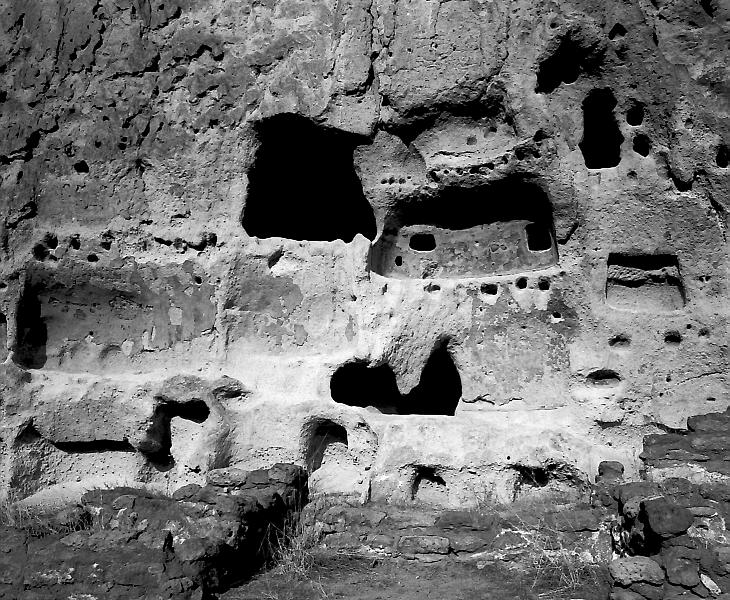 Further north are the cave dwellings at Bandelier National Monument, an old settlement of The Ancient Ones, people that came to the area over 12,000 years ago. That’s 10,000 B.C.! (ancient = long, long time). A few groups comprise the ancient pueblo people; the Anasazi and Hopi are among them. Archaeologists think that hunter/gatherers migrated from the four corners area and started settling the Pajarito Plateau around 1100. Here, they took up farming and by 1150 the place was hoppin’ (so to speak). It kept growing and thriving until a couple of new groups of people came along, Navajo and Apache. The Ancient Ones were deeply spiritual and peaceful, not warriors like the newcomers. For this reason, they moved down to the desert floor, around 1300. At this date, the Ancient Ones become referred to as the Pueblo People.
 The national monument makes a good side trip after lunch, and of course, there is a museum and gift shop just in case you want a souvenir. I can't remember if the monster rock is before or after Bandelier National Monument, but you'll miss it if you drive south. Driving north, the rock is on the left.
Before you get to Bandelier National Monument, you'll drive along the rim of a caldera which is a sunken volcano. Crater Lake is a famous caldera. If you look at the Google map in hybrid view, you'll notice the arced section of road skirting the rim (and if you back out, you'll see the whole crater). Up here is beautiful Ponderosa Pine parkland.
Further still, you'll reach Los Alamos, home of Los Alamos National Laboratory, of Manhattan project fame, where Oppenheimer and all of his propeller-head buddies invented the atomic bomb. There is a free science museum here at the lab (they have Lasers there).

Keep on driving and you'll finally roll in to Santa Fe, but not before you pass Camel Rock, one of Tinsley's favorite US landmarks. A lot of stuff has happened here in central New Mexico from millions of years of erosion sculpting Camel Rock, to the ancients settling the area 12,000 years ago, to the atomic age of the mid twentieth century. It ought to make good conversation along the drive.
Subscribe to:
Posts (Atom)


 Posts
Posts